Guided meditation audio tends to fall into one register: slow, even, pitched slightly downward, and held there for the whole track. If that register does not match the way you talk to yourself, a small part of your attention stays on the voice instead of on the thing the voice is pointing at, and the instruction to soften your jaw competes with the accent delivering it. None of that is a failing of the narrator, it is what happens when one track is recorded for a hundred thousand strangers and the pace has to be guessed at once, for all of them.
Recording the same practice yourself removes the guessing. You write the line, you say it at the speed you would actually say it, you leave the pause you actually want, and the version you play back next week is the one you built. Selfime exists because that changes what listening feels like, and the change comes from the words being yours and from the voice being yours.
What changes when the words are yours
Generic guidance has to stay general. “Notice any tension you are holding” has to work for a person with a sore shoulder, a person clenching their jaw, and a person who is not holding tension anywhere, so it names none of them. Your own script can say the specific thing: the left shoulder that goes up when the inbox loads, the habit of reading the first message before getting out of bed, the ten minutes between the car and the front door.
Specificity is not just more accurate, it is easier to act on. A line that names something you can locate gives your attention a destination, and every line in the scripts that ship with Selfime has to point at something you can sense or do right now, in your body or your room. A line you wrote yourself starts one step ahead of that, because you already know what it refers to.
The memory argument comes from Symons and Johnson, who published a meta-analysis in Psychological Bulletin in 1997 covering many experiments on what is called the self-reference effect, and the pattern across them is that material processed in relation to yourself is recalled better than material processed for its meaning alone. That work was done with word lists and recall tests in laboratories, not with meditation scripts, so treat it as a reason to expect your own phrasing to stick rather than as evidence that it will. You can check it on yourself by reading back a script you wrote three months ago and seeing how much of it you still recognise.
You do not have to start from a blank page for any of this. Selfime ships 50 guided practices, six of them free, and the ordinary way to work is to open one that is close to what you need and edit the lines that are not. A Blank Tape is there for the days when you would rather write the whole thing.
What changes when the voice is yours
Hearing your own recorded voice for the first time is usually unpleasant, and part of the reason is mechanical. When you speak, the sound reaching your inner ear travels both through the air and through the bone and tissue of your skull, and the bone-conducted path carries the low frequencies better. The voice you have heard your whole life is therefore fuller and lower than the one a microphone picks up. The recording is not distorted, only missing the low end you are used to, and it is the version everyone else has always heard, which is why it can sound thin or higher-pitched or oddly young.
That reaction fades with exposure, and faster than people expect. After a handful of playbacks the strangeness stops being the loudest thing in the room and the words come forward again. If you can get through the first two or three listens, the problem usually solves itself.
Once the strangeness goes, what is left is a change in where the words seem to come from. A thought you think is inside the argument you are having with yourself, and the same sentence, recorded and played back, arrives from outside as something addressed to you. Ethan Kross and colleagues reported a set of experiments in the Journal of Personality and Social Psychology in 2014 showing that people who referred to themselves by name or as “you” while thinking through a stressful task, rather than as “I”, performed better under social stress and ruminated less about it afterwards. The manipulation there was linguistic and silent, done in the lab with speech tasks and short-term measures, and none of it involved recording anything or a meditation practice. So the connection to a recorded tape is an argument about mechanism, not a result anyone has demonstrated.
Still, it is the closest thing to a description of what playback feels like. The advice is yours, you agreed with it when you wrote it, and hearing it spoken puts a small distance between you and it, which is exactly the distance that makes advice usable.
The loop, and what a downloaded track cannot do
The practical difference is that a recorded practice is a circuit rather than a delivery. A downloaded track is someone else’s words in someone else’s voice, you listen, and nothing comes back to you. A tape you make yourself has a return path: you choose or write the words, you say one card at a time, you keep or redo the take, and you listen later, which sends you back to the words again.
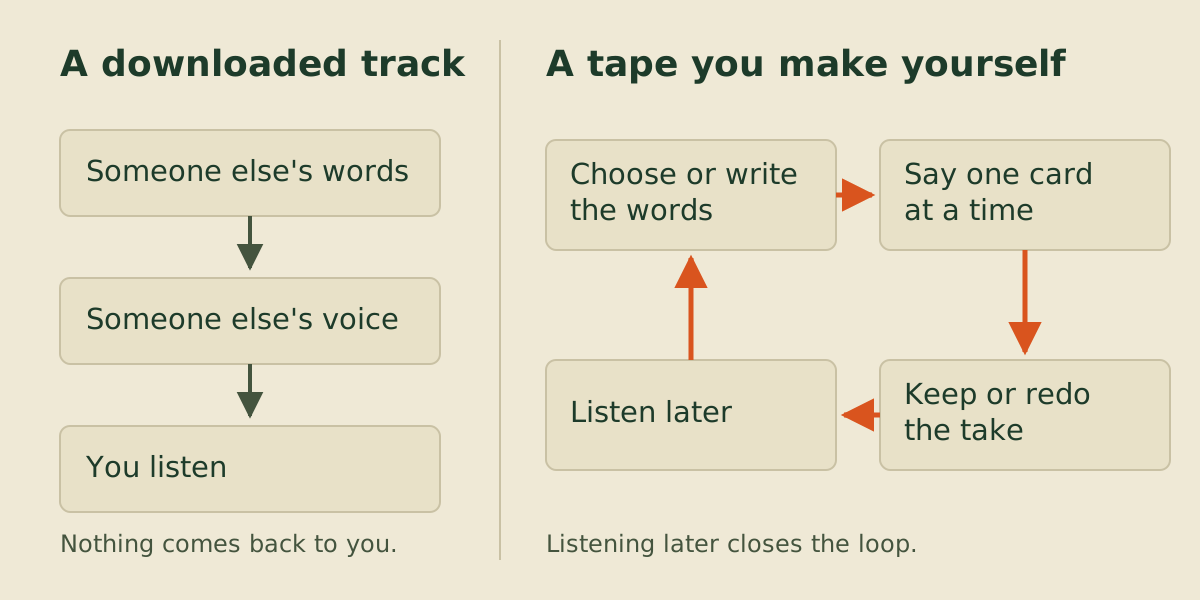
Recording works one card at a time. A card is one line of the script, shown on its own, and you record it, hear it back, and either keep it or redo it before moving to the next. Nobody has to perform a whole meditation in a single unbroken take, which is the thing that stops most people trying. If the third line came out rushed you redo the third line.
Listening later closes the loop, and it is the part that changes the writing. You find out on playback that a line you were pleased with is too long to follow, or that a pause you thought was generous is not, and you go back and change it. After a few passes the script stops being something you wrote and becomes something that works on you, which is a different and better standard.
If you would rather not record at all, Read-Along shows the same script one card at a time in silence, holding each card for as long as reading it takes and then the pause written after it. Plenty of people use that first and record later, or never record at all.
Who this suits, and who it does not
It suits people who already talk to themselves in a particular way and would like to hear it back. It suits anyone who has abandoned meditation apps because the narrator’s pace was wrong, either too slow to hold attention or too quick to follow. It suits people who want a practice that names their actual circumstances, and it suits people who are going to be somewhere they know is hard and would like to leave themselves something for it.
It does not suit everyone. Some people find their own recorded voice grating past the point where repetition helps, and there is no reason to fight that; following a practice someone else recorded is a perfectly good way to meditate, and it is why six guided practices and a Blank Tape are in the free edition without any recording required. If speaking aloud is difficult, or if hearing yourself is loaded for reasons that have nothing to do with pitch, Read-Along and Breathe do not ask you to say anything.
Breathe does not use words at all. It paces the breath with a metronome in one of four patterns, and the separate guide to those patterns covers the timings and who should skip the holds.
Start with a two-line practice
The smallest useful version takes about a minute. Pick a moment you already know is difficult and write two lines for it, each short enough to say in one easy breath, each pointing at something you can feel or do on the spot. Something like “Both feet are on the floor. Feel the weight of them” and “One slow breath out, longer than the one in”, with a pause after each. Record the first card, listen, redo it if you rushed it, then record the second.
Then leave it alone until the moment it was written for. The gap matters, because the words were chosen by you at your most sensible, in your own voice, waiting for a version of you who has less patience available, and a tape can also be sealed for a date, or for a situation you name and open when it arrives. Two lines is enough to find out whether hearing yourself helps. If it does, the script grows from there.
References
Kross, E., Bruehlman-Senecal, E., Park, J., Burson, A., Dougherty, A., Shablack, H., Bremner, R., Moser, J., and Ayduk, O. (2014). Self-talk as a regulatory mechanism: How you do it matters. Journal of Personality and Social Psychology, 106(2), 304 to 324. doi:10.1037/a0035173
Symons, C. S., and Johnson, B. T. (1997). The self-reference effect in memory: A meta-analysis. Psychological Bulletin, 121(3), 371 to 394. doi:10.1037/0033-2909.121.3.371