Writing a letter to yourself and reading it years later is an old practice, and it has had a home on the internet for more than twenty years at FutureMe.org, where you type something, choose a delivery date, and the site emails it back when that date arrives. The appeal is obvious enough that most people understand it immediately, and a letter still leaves a great deal out that a recording keeps.
A letter preserves what you decided to say. A recording preserves how you were when you said it: the tiredness in the voice, the sentence that starts twice, the pause before the difficult part, the small lift when you get to the thing you actually meant. None of that survives typing, because typing lets you arrive at the sentence before the reader does. Speaking does not. If you record in one sitting and do not go back and redo the awkward parts, the tape carries the shape of the day it was made on, and that turns out to be most of what you want from it later.
Why hearing a past version of yourself is different from reading one
When you read something you wrote two years ago, you translate it. The words go through your current voice in your head, in your current mood, at your current reading speed, and by the time they land they sound like your present self talking. That is why old diary entries can feel embarrassing or flat, since you are performing them with today’s inflection and the only thing left to react to is the content.
A recording refuses that. It plays at its own speed, in a voice that is recognisably yours and audibly not quite you as you are now, and the difference between the two is exactly the information a letter loses. You hear where you were rushing. You hear the sentence you did not finish. Someone who recorded a tape three weeks into a difficult month can hear the difficult month in it, even if the words carefully avoid saying so, and that is often more useful than what the words report.
What the research does and does not say
There is a body of work in psychology on what Hershfield (2011) calls future self-continuity, which is the degree to which you experience the person you will be as continuous with the person you are. Ersner-Hershfield, Garton, Ballard, Samanez-Larkin and Knutson (2009) found that people who reported feeling more similar to their future selves also had more accumulated savings, and related brain imaging work has shown that thinking about the future self can look, in some people, more like thinking about a stranger than about oneself.
There are two limits here. That literature is about saving and intertemporal choice, which is to say money and delayed rewards, and not about recorded messages, so using it to explain why a tape works is an inference rather than a finding. The savings result is also correlational and self-reported, so it does not establish that strengthening the sense of continuity causes anyone to behave differently. The narrower and still useful point is that the future self is easy to treat as somebody else, and that vivid contact with that person is not something the mind produces on its own. A recording is a deliberately concrete way of making that contact, which is a mechanism worth trying rather than a proven effect.
What to say
The best tapes are descriptive rather than instructive. Say where you are, what the week has contained, what you are unsure about, and what you want the listener to remember. Then stop. Advice you would not take today does not improve with age, and a tape that tells your future self to be disciplined is a tape that will be switched off around the 90 second mark.
Naming what you are unsure about is the part people skip and later value most. Certainty dates badly. A recorded worry that turned out to be nothing is funny to hear, and a recorded worry that turned out to be real is company, because it means the version of you who was worried had already worked out something true.
Prompts worth answering on tape:
- What is happening this week, described concretely enough that you would not recognise it as any other week.
- What you are unsure about, said as a question rather than a resolution.
- Something you are avoiding, and the reason you give yourself for avoiding it.
- What you want to still be true when this plays back.
- Something small and good from the last few days, named exactly.
- What you would want to hear if the tape catches you at a bad moment.
- One thing you would like the listener to stop carrying.
Seven prompts is more than one tape needs. Choose two or three and let the rest go.
The two kinds of seal, and when each fits
In Selfime, a recording kept for later is a Sealed Tape, and the seal you choose decides when it is delivered to you.
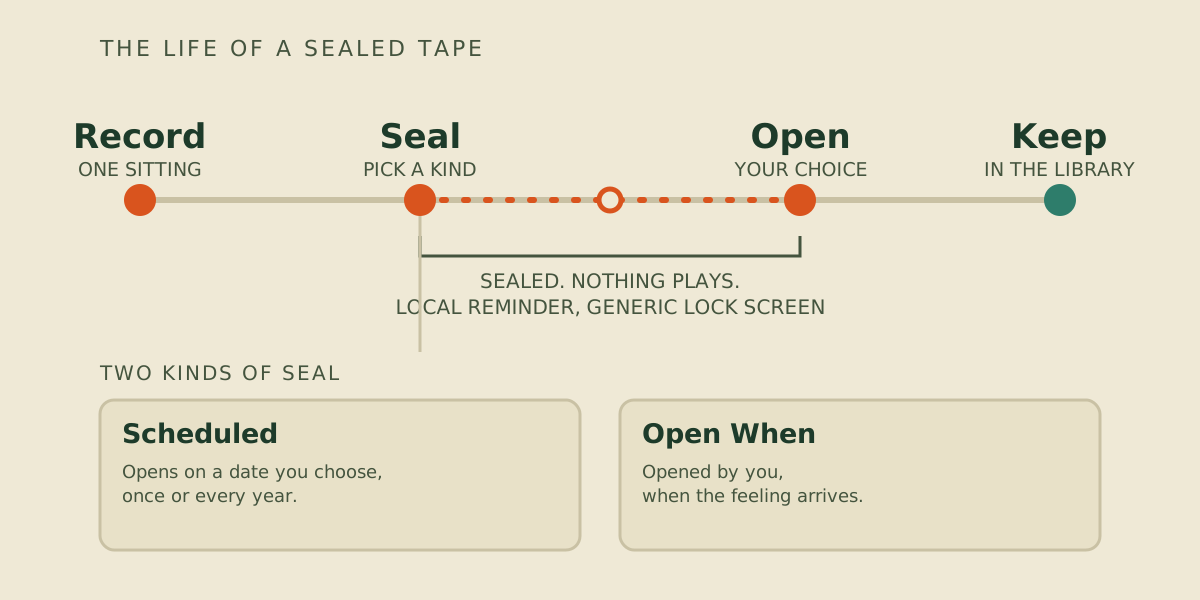
Scheduled is delivered on a date you choose, with presets from a week away to a year and a custom date beyond that. The seal is a promise rather than a padlock, so the tape still sits in your library and the app will play it if you go looking, but the delivery and its reminder wait for the day. It suits anything that has a natural distance to it, such as a tape recorded the night before you started a new job, sealed for six months, so the person doing the job hears the person who was nervous about getting it. A scheduled tape can also be set to repeat every year on the same date, which is the version for anniversaries in the plain sense of a date that carries weight: the day something ended, the day something started, a birthday you would rather mark than skip past.
Open When is sealed for a situation or a feeling instead of a date, and it is opened by your own choice rather than by the clock. The app offers a set of these, including anxious, sleepless, doubting, low, before something big, and needing courage. A tape sealed as open when you cannot sleep, recorded on an evening when you were calm and had the words available, is worth more at two in the morning than anything you could compose at two in the morning.
The free edition includes one Sealed Tape delivery, which is enough to find out whether you like hearing yourself in the future tense. Lifetime removes the limit.
Recording it, sealing it, and what happens in between
Record in one sitting. Not because a polished tape is worse in principle, but because the redone version is a performance of the day rather than the day itself, and the performance is the thing that ages badly. Keep it under a few minutes. A tape of 90 seconds gets played to the end; a tape of twelve minutes gets started, and started again a week later, and never finished.
Once you seal it, the deck leaves it alone until the seal is satisfied. When the date arrives, the reminder comes from your own phone, scheduled locally, and its lock-screen text stays generic, so a notification landing while somebody else is looking at your phone gives away nothing about what is inside. The tape itself is encrypted and stays on the device. Selfime has no account and never receives a copy. On Android, the only way a sealed tape travels to a new phone is inside an encrypted Recovery Kit, opened with your own 12-word recovery code; on iPhone and iPad an encrypted iCloud or computer backup can carry the library across as well, and the kit is the fallback when a transfer leaves the key behind. Either way nobody at Selfime can retrieve it for you, which is the trade for the privacy.
The small ritual of opening one
Give the opening the same care as the recording. Put headphones on, sit down somewhere you are not about to be interrupted, and listen the whole way through without skipping, because the parts you would skip are usually the parts carrying the tone. Do not respond to it immediately. If you want to answer, record the reply as a new tape and seal that one too, which is how people end up with a thread rather than a novelty.
Afterwards, an opened tape can stay in your library like any other, be sealed again for a later date, or be deleted. Keeping it is worth considering even when the contents make you wince, since the wince is a measurement of distance travelled and you cannot take that measurement twice.
If you are going through a hard stretch, a tape from a better period can be steadying, and it can also arrive as evidence of what you have lost. You know which you are more likely to get. Selfime is a recorder and not a medical device, and a Sealed Tape is not treatment, so if low mood or anxiety is persistent, or a date you are sealing a tape for is one you are dreading, that belongs with a clinician rather than with your future self.
References
Ersner-Hershfield, H., Garton, M. T., Ballard, K., Samanez-Larkin, G. R., & Knutson, B. (2009). Don’t stop thinking about tomorrow: Individual differences in future self-continuity account for saving. Judgment and Decision Making, 4(4), 280 to 286. doi:10.1017/S1930297500003855
Ersner-Hershfield, H., Wimmer, G. E., & Knutson, B. (2009). Saving for the future self: Neural measures of future self-continuity predict temporal discounting. Social Cognitive and Affective Neuroscience, 4(1), 85 to 92. doi:10.1093/scan/nsn042
Hershfield, H. E. (2011). Future self-continuity: How conceptions of the future self transform intertemporal choice. Annals of the New York Academy of Sciences, 1235, 30 to 43. doi:10.1111/j.1749-6632.2011.06201.x