
Breathe is the part of Selfime with no words in it. You pick one of four patterns, set a length, and the screen and the haptics keep time while you follow. The four patterns look quite different written down, and two of them are widely taught under names people search for by name, so it is worth setting out what each one actually asks of you and what happens to your breathing when you do it.
Every timing below is the timing the app runs. Nothing here is medical advice, and Selfime is not a medical device.
The four patterns and their exact timings
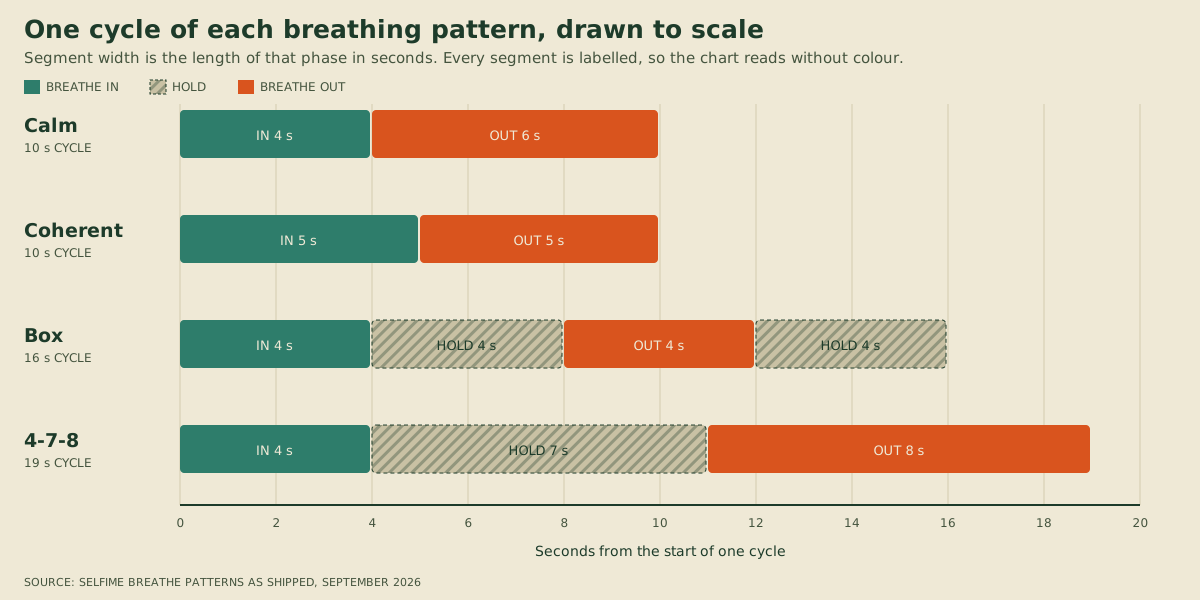
Calm is 4 seconds in and 6 seconds out, with no holds, so one cycle takes 10 seconds. Coherent is an even 5 seconds each way, also a 10 second cycle. Coherent breathing is often taught at 5.5 seconds in and 5.5 seconds out, which works out at about 5.5 breaths a minute; Selfime rounds to an even 5 so the count lands on whole seconds and the rate comes out at exactly six. Box breathing is four equal phases of 4 seconds, breathe in, hold, breathe out, hold, a 16 second cycle. 4-7-8 is 4 seconds in, a 7 second hold, and an 8 second exhale, which is a 19 second cycle and the longest of the four.
| Pattern | Phases | Cycle | Breaths a minute |
|---|---|---|---|
| Calm | 4 in, 6 out | 10 s | 6.0 |
| Coherent | 5 in, 5 out | 10 s | 6.0 |
| Box | 4 in, 4 hold, 4 out, 4 hold | 16 s | 3.75 |
| 4-7-8 | 4 in, 7 hold, 8 out | 19 s | about 3.2 |
Why every pattern lands near six breaths a minute or below
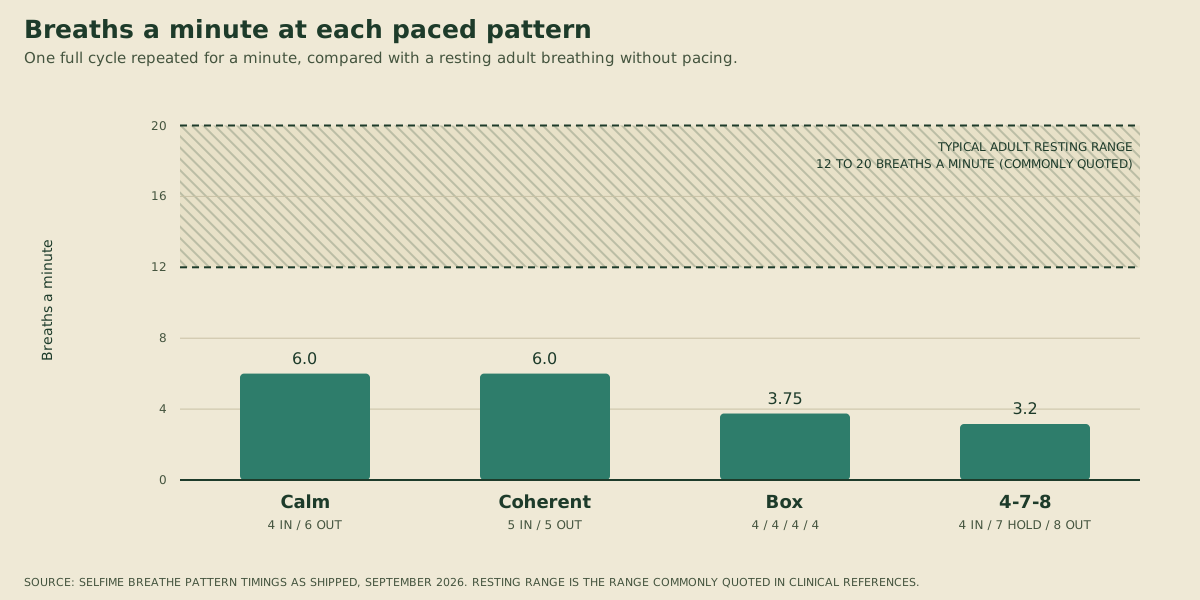
An adult sitting still and not thinking about it is usually quoted as breathing somewhere between 12 and 20 times a minute. Every pattern in Breathe cuts that by at least half, and the two patterns without holds land on six exactly. Six is the rate the biofeedback literature keeps returning to. Lehrer and Gevirtz (2014) describe how breathing at around six breaths a minute lines the breath up with the slower rhythms already running in blood pressure control, so heart rate swings widest with the breath at roughly that pace, and their review is the standard reference for why heart rate variability biofeedback trains people towards it. The exact rate that does this differs from person to person, usually landing between about 4.5 and 6.5 breaths a minute, which is one reason the app offers more than one even pace rather than a single correct one.
Zaccaro and colleagues (2018) reviewed the broader literature on slow breathing and found a fairly consistent pattern of reported effects on comfort, alertness and relaxation, along with changes in heart rate variability. Their own summary is careful about it, noting that the studies they collected use small samples, varied protocols, and inconsistent definitions of what counts as slow, so the review establishes a direction rather than a dose. Read it as evidence that slowing down does something measurable, not as evidence that 5 seconds beats 5.5.
The longer exhale, and why it is the part you can feel
Calm and 4-7-8 both spend more time breathing out than in, and of everything in Breathe this is the element people notice first. Heart rate rises a little as you breathe in and falls as you breathe out, so a longer exhale lengthens the falling part of each cycle. You do not need to detect that to benefit from the structure, because a 6 second exhale is long enough that you have to let it out slowly and evenly, which is a more demanding piece of motor control than the inhale and gives your attention something concrete to sit on.
Balban and colleagues (2023) compared three breathing practices with mindfulness meditation over a month and reported the largest improvement in daily mood, and the largest drop in breathing rate, for cyclic sighing, a practice built around a deliberately extended exhale. The study ran remotely, the practice was self-reported and unsupervised, and mood was measured by questionnaire rather than anything physiological. It is one month of self-report in one sample, not a settled result, and cyclic sighing is not one of the four patterns Selfime ships. What it supports is the general shape, that a practice weighted towards the out-breath tends to be the one people find useful.
If you are new to paced breathing, Calm is the pattern to start with. It has no holds, the ratio is gentle, and 4 seconds in is close enough to an ordinary breath that you are only changing one thing at a time.
Box breathing: 4-4-4-4, and who should leave the holds alone
Box breathing is the pattern most often taught for composure under pressure, and its appeal is structural rather than physiological. Four equal phases give you a count that never changes, an even rhythm with no ratio to remember, and a shape that is easy to hold in mind when your attention is scattered. At 3.75 breaths a minute it is also slower than either of the even patterns, because the two holds take up half of every cycle.
The direct evidence for box breathing specifically is thin. It is popular in military and emergency-services training and it borrows plausibility from the slow breathing literature above, but the controlled trials on this particular 4-4-4-4 arrangement are few and small, and none of them establish that the holds add anything over simply breathing slowly for the same length of time.
Holds are the part to be careful with, so if you have a respiratory condition such as asthma or COPD, a cardiovascular condition or high blood pressure, if you are pregnant, or if you have a history of panic disorder, skip them and talk to your doctor before practising a paced pattern at all. Breath holding can provoke the same chest tightness and air hunger that a panic response feeds on, which is the opposite of what you came for. If you feel light-headed, dizzy or short of breath at any point, stop the hold and let your breath find its own rhythm again. Calm and Coherent give you the slow pace without any of this, and they are the sensible substitutes.
4-7-8 breathing: the longest hold, the thinnest evidence
4-7-8 asks for the most, with a 7 second hold after a 4 second inhale, then an 8 second exhale, at a total of about 3.2 breaths a minute. It was popularised by Andrew Weil, who teaches it as a wind-down practice and recommends a small number of cycles rather than a long session. There is no substantial trial base behind the specific 4:7:8 ratio, and claims that this exact count does something the other slow patterns do not are not supported by published evidence.
That does not make it useless, since the long exhale is real, the count is demanding enough to occupy your attention completely, and some people find that the demand is exactly what pulls them out of a spiral at bedtime. Treat it as a structure that some people like rather than a protocol with a mechanism behind it, and give it a short session rather than a long one.
The same caution applies here as to box breathing, and more so, because the hold is nearly twice as long. Anyone with a respiratory or cardiovascular condition, anyone pregnant, and anyone with a history of panic attacks should skip this pattern and check with a clinician before taking up a hold based practice. If 7 seconds feels like too much on any given cycle, let the hold go and breathe out. The app says the same thing on the screen: keep the pace comfortable, skip any hold or return to natural breathing whenever you need.
How long should a session be?
Two to five minutes is where most people should start, and it is long enough to matter. At Calm’s 10 second cycle, five minutes is 30 breaths, which is more deliberate slow breathing than most days contain. At 4-7-8 the same five minutes is under 16 cycles, and that is plenty for a pattern that demanding.
Selfime’s duration control offers 1, 2, 5, 10, 20 and 30 minutes. Free sessions run up to five minutes with Rain ambience, and Selfime Lifetime adds the 10 to 30 minute lengths along with every other soundscape. The longer sessions are worth having once a pattern has become automatic and you stop counting, but reaching for 20 minutes on your first attempt usually just means finishing early.
Ticks, vibration and ambience, and when to switch each off
Three toggles sit on the session screen, and each one carries the pace in a different sense, so the right combination depends on where you are and what you can attend to.
- Ticks mark the phase changes with a short sound. Useful with your eyes closed and useless in a shared office. Turn them off once you know the count.
- Vibration marks the same transitions through the phone’s haptics, which is the one cue that works with the phone face down in your pocket or on a desk beside you. It is also the cue to lose first if the buzz itself is what is keeping you alert.
- Ambience sits underneath rather than marking anything, and it is there to cover a noisy room. Rain is included in the free edition. If you find yourself listening to the rain instead of following the pattern, switch it off.
Running with everything off and only the visual is the quietest option, and it is often where people end up after a week or two. There is no version of this that works better with more cues on, because the cues exist so you do not have to count, and counting is the part you eventually stop needing.
The rule that overrides all of it
Selfime shows the same line beside every paced pattern: keep the pace comfortable, skip any hold or return to natural breathing whenever you need. That line is there because a pattern that leaves you short of breath is not working, whatever the timings say, and the fix is to drop the hold, shorten the count, or stop and breathe normally. None of these four patterns is a treatment for anxiety, insomnia or anything else, and if breathlessness, dizziness or panic is a regular feature of your life, that is a conversation for a doctor rather than an app.
References
- Lehrer, P. M., & Gevirtz, R. (2014). Heart rate variability biofeedback: how and why does it work? Frontiers in Psychology, 5, article 756. doi.org/10.3389/fpsyg.2014.00756
- Zaccaro, A., Piarulli, A., Laurino, M., Garbella, E., Menicucci, D., Neri, B., & Gemignani, A. (2018). How breath-control can change your life: a systematic review on psycho-physiological correlates of slow breathing. Frontiers in Human Neuroscience, 12, article 353. doi.org/10.3389/fnhum.2018.00353
- Balban, M. Y., Neri, E., Kogon, M. M., Weed, L., Nouriani, B., Jo, B., Holl, G., Zeitzer, J. M., Spiegel, D., & Huberman, A. D. (2023). Brief structured respiration practices enhance mood and reduce physiological arousal. Cell Reports Medicine, 4(1), 100895. doi.org/10.1016/j.xcrm.2022.100895