A script you are going to record is written under different habits from one written for someone else to narrate. The person reading the script aloud is the person who will hear it back, and the rest follows from that. There is no narrator to rescue a clumsy sentence and no producer to trim a line that ran out of air. If you are writing your first guided meditation script, for the app or for a piece of paper propped against your bedside lamp, what follows is the shape and the handful of habits that hold up, and they are mostly about breath rather than about prose.
A script is a set of cues, not an essay
A guided meditation script is closer to a list of stage directions than to an article. Each line is a cue that points attention somewhere the listener can actually go: the weight of the feet, the sound in the next room, the belly rising, one deliberate thought held for a few seconds. If a line can be neither sensed, performed, nor thought on purpose, it does not belong, no matter how good it looks on the page.
That test removes a surprising amount of writing. “Let yourself sink into a deep sense of peace” cannot be done on command, so it becomes an instruction to fail at. “Feel where your shoulders touch the back of the chair” can be done immediately, by anyone, in any state. When you are stuck for a line, ask what the listener’s next four seconds should contain, and write only that.
The same test applies to what you claim. Offer a sensation rather than asserting one, since “there may be warmth, or pressure, or nothing much at all” is honest while “you feel warmth spreading” tells the listener something you cannot know.
One line per breath
Write every line so that it can be spoken in one easy breath, which for most people is somewhere between ten and twenty words. That is not a figure imported from research, since no study fixes the length of a meditation line. It comes out of reading drafts aloud and noticing where the reading breaks.
Past roughly 25 words you either take a mid sentence breath, which puts an audible gasp exactly where the listener is meant to be slowing down, or you speed up to reach the full stop. Long lines also tend to carry subordinate clauses, and a subordinate clause obliges the listener to hold the first half of the sentence in mind while the second half arrives, which is attention spent on grammar rather than on the shoulders. At the short end, a line of four or five words lands too fast to follow, and a run of them sounds like a countdown.
The arc of a standard script
A practice of a few minutes has room for a few dozen lines, and the shape that holds up moves through six stages in order, each of them read one line per breath.
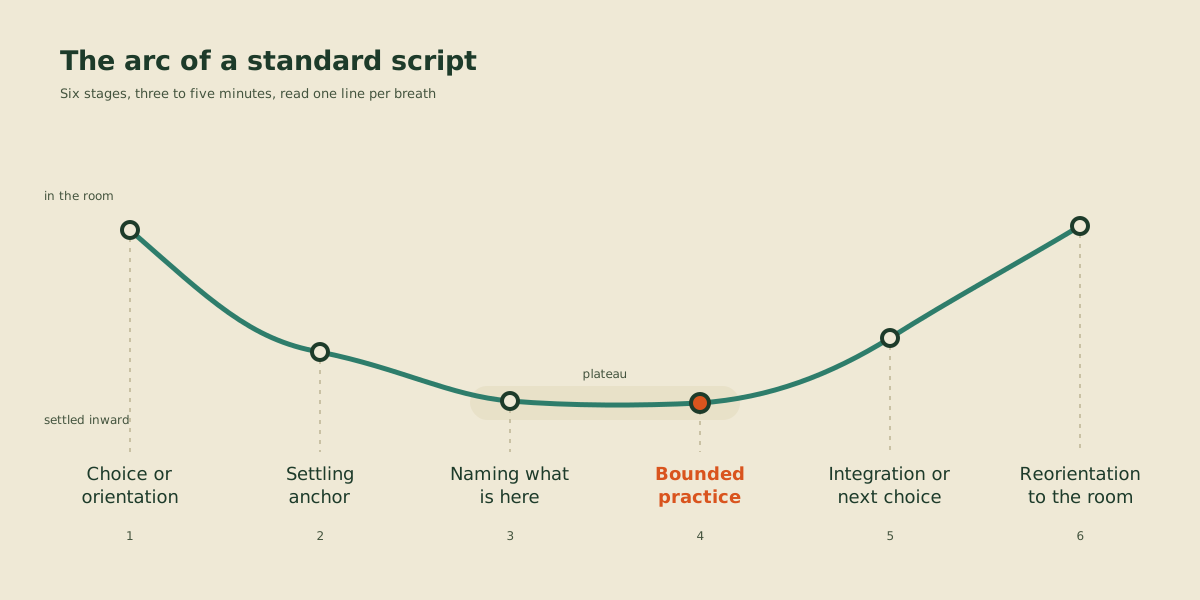
Choice or orientation comes first, and it is consent rather than ceremony. Offer a position that already works, eyes open or closed, permission to move and permission to stop, in about two lines.
Settling anchor gives attention one place to land. A contact point works better than the breath here, because breath focus can be activating for some people, and a script that has named the chair or the floor has a fall back ready.
Naming what is here is the stage most first drafts skip, and it says the hard thing plainly before offering anything else. A line like “this is a lot, because it is a lot” earns the rest of the script in a way that a reassurance cannot.
Bounded practice is the middle, marked at the plateau on the diagram because the level stays flat here rather than building. One anchor, held, with a kind return whenever attention wanders, and an edge you decided on in advance, so the listener knows the practice will end.
Integration or next choice turns the practice back towards the rest of the day: one feasible thing, sized to the state the listener is in, phrased as a choice rather than a task.
Reorientation to the room brings attention back out through sound, light, or the feel of the floor. Lower on the curve is more settled inward and the last stage is where the listener is back in the room, which is why sleep practices are the exception, since they can close without asking anyone to open their eyes. A short practice, a handful of lines rather than a few dozen, uses a compressed version of the same shape.
First person or second person
The app sets perspective deliberately, and the split is by scenario rather than by taste. Inward, self-compassionate scripts are written in first person: “I can let my jaw loosen”, “I do not have to fix this tonight”. Hearing your own recorded voice say “I” removes the strange gap where a stranger tells you what you feel, and it makes a kind line easier to accept, because you are the one saying it.
Scripts that steady someone before an event go into second person: “feel your feet”, “your hands can rest wherever they are”. Second person carries instruction better, and before a difficult conversation most people want to be led rather than to narrate themselves. Whichever you pick, hold it for the whole script, because a perspective that slips halfway through is obvious on the first listen.
Pauses are part of the writing
A script with no pause schedule is only half written. Write the pause after each line at the same time as the line, because the two of them together are what the running time is made of, and the pause is doing at least as much of the work. Read at about 150 words a minute, unhurried speech rather than performance, with a floor so a short line still gets a moment on screen.
Pauses run from a few seconds after a short, concrete line to a good deal longer in the middle of a practice, where the holding is the point rather than the words. The closing line takes no pause at all, because silence after the last line is only the app appearing to have stopped working.
You can check a script before recording it by adding up the spoken time and the pauses and comparing the total against the length you intended. When a draft comes out shorter than you wanted, the fix is almost always longer pauses rather than more lines, since more lines is how a practice turns back into an essay.
What goes wrong in a first draft
Four faults account for most of the rewriting.
- Instructions that demand a result. “Relax your shoulders”, “clear your mind”, “feel calm”. None of these can be performed on request, so they convert into small failures. Direct attention instead of ordering an outcome: “notice what your shoulders are doing” always works.
- Metaphors that need decoding. Interior space metaphors are the worst offenders, because a listener trying to find the room inside themselves has left their body entirely. Literal support is fine, since letting the bed hold what you cannot hold asks nothing to be decoded.
- Two instructions in one line. “Soften your jaw and lengthen your exhale” splits attention at the moment you were gathering it. One move per line, every time, and give sequential actions their own lines with a word like now or then to escort attention across.
- Anything you cannot say in one breath. Read the draft aloud before you believe any of it. The lines that fail are audible immediately, and they are usually the ones you were proudest of.
A fifth, quieter fault is teleporting attention, since moving from the feet straight to the face leaves the listener guessing what happened in between. Attention travels better along adjacent stops, from the ground to the hands to the shoulders to the face to the breath, in one direction per script.
A micro script for a night when your mind will not slow down
Here is a complete micro practice written for this post, in first person, for the specific case of lying awake with a mind that keeps going. Seven lines, each short enough for one breath, with a pause after each one, and a running time of about a minute and a half. Leave a few seconds after the opening lines, noticeably longer once attention has settled on the body, and nothing after the last line.
- “My mind is still going at this hour, and I do not have to argue with it tonight.”
- “I can leave my eyes open or let them close, whichever is easier right now.”
- “I can feel where my body meets the bed or the chair, and let that contact hold me.”
- “Now I bring my attention to my hands, and notice weight, warmth, or nothing much at all.”
- “Then I let my attention rest on my belly, rising and falling on its own.”
- “A thought has probably arrived already. That is natural, and I can come back to the belly.”
- “I can stay with the belly for a few more breaths, and let the night go on without me.”
Line 3 offers contact before the breath on purpose, so anyone who finds breath focus uncomfortable has somewhere else to be. Line 6 does the wandering handling: name it, normalise it, return, and never scold. Nothing promises sleep, because a script that promises sleep gives you something new to fail at when you are already awake at two in the morning.
This is a practice, not treatment. Sleeplessness that persists for weeks, or nights spent with thoughts that frighten you, are worth raising with a doctor rather than managing alone with a recording. Selfime is not a medical device, and breath focused practice can feel activating for people with panic symptoms or breathing conditions, which is why the alternative anchor in line 3 is there.
Speaking the script instead of typing it
Most of the drafting can be done out loud, which suits a script that is going to be spoken anyway. In Selfime the script screen has a Speak your script path that takes one segment at a time: you say a line, the phone’s own speech recogniser turns it into text on the device, you read what came back, keep it or say it again, and set the pause that follows before moving to the next. A line that is awkward to say tends to come out wrong in the transcript, which is a useful early warning that it would have been awkward to record as well. The text stays editable afterwards, so the arc and the one-move-per-line rule can be tidied on the page once the raw material is down.
If you already have a practice you know by heart, or one you wrote years ago on paper, you can also skip the script entirely and record it straight onto a blank tape, in as many takes as you like. A transcript of each take can be made on the device afterwards if you turn transcription on in settings, which gives you the words back as text and lights them up as the tape plays. It is off by default and never leaves the phone.
Writing your own
Start with one situation you have actually been in, at the length you would realistically press play on, which for most people is the micro format. Write the six stages as six headings, fill each with lines you can say in one breath, typed or spoken, then read the whole thing aloud with a timer before deciding it is finished. In the app a draft can go on a Blank Tape and be recorded a card at a time, so a card that comes out wrong can be redone without starting the take again.